Showing posts with label Army Air Force. Show all posts

Sunday, January 2, 2022

Omer William Lammers (1920-1945)

I started watching a series on Netflix called "Stories of a Generation". The series focuses on the generation who are now in their 70s being interviewed by a generation of filmmakers who are in their 30s. The series consists of four episodes; Love, Dream, Struggle, and Work. During the Struggle episode, Omar Badsha made the following statement: "We must not forget who makes history. We need to write a new history. It is a history not of big names and big people. It is a history of ordinary people. They are the ones who make history. That legacy is something that we must keep around." Omar's story revolved around appartheide South Africa and the struggle for equality and freedom, but his statement is much broader than that. The intent of my posts in this blog have been just that, telling the history that our ancestors have contributed to so others will see their contributions. My most recent series of posts, the WWII Hometown Newspapers Collection Project, revolves around their service during WWII which the US entered 80 years ago.

Today's post is about Omer William Lammers, my wife's 4th cousin 2x removed.

Omer was born in Botkins, Shelby County, Ohio on 9 January 1920. His parents were William Louis Lammers and Emma Marie Kipp Lammers. He had one sister, Mildred Sophia, born in 1915, and one brother, Richard Lewis, born in 1926.

Omer is not listed in the 1920 US Census because his bithdate was after the 1 January 1920 cutoff for listing. But the rest of the family, William (age 31), Anna (age 29), and Mildred (age 5) are listed as renters on the farm of William Kipp (age 59)  in Van Buren Township, Shelby County, Ohio. William Lammers is listed as the farm manager. William Kipp, born in Germany, was Emma Kipp's father. Also note that Emma was recorded as Anna in this census.

The 1930 US Census has the family still living with William Kipp (age 70) in Van Buren Township, Shelby County, Ohio. The family consisted of William Lammers (age 41), Emma (age 39), Mildred (age 15), Omer (age 10), and Richard (age 4 years 5 months). The census indicates that William and Emma were married when they were 26 and 24 years old respectively. William Lammers was a farmer and his farm was listed as #63 on the farm schedule. The 1930 census is incorrectly indexed as Somers instead of Lammers.

Omer attended New Knoxville High School where he graduated with the class of 1937. He was employed by Ed Holl and worked as a ditching contractor.

During the 1940 US Census, the family consisted of William Lammers (age 51), Emma (age 49), Mildred (age 25), Omer (age 20), Richard (age 14), and William Kipp (age 80). William Lammers and his wife Emma had completed the 8th grade. Mildred and Omer had completed 4 years of high school and Richard had finished his first year of high school at the time of this census. William Kipp had completed 5th grade before immigrating to the US from Germany. The family still lived on the farm and William rented it for $10 per month. The farm is listed on the 1940 farm schedule as farm #210.
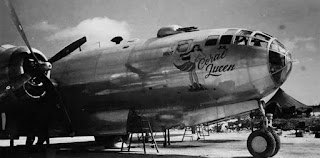
On 18 January 1941, Omer enlisted in the Army at Ft. Hayes in Columbus, Ohio. He underwent training at Chanute Field near Rantoul, Illinois and had his B-29 combat crew training at Fairmont Army Air Field in Nebraska. He achieved the rank of Technical Sergeant and was assigned to the 398th Bomber Squadron, 504th Bomber Group on 23 December 1944. He was deployed in the Pacific theater out of Tinian Air Field in the Marianas Islands. This was the busiest airfield of the war with six 7,900-foot runways and over 50,000 troops stationed there. Missions were flown with targets in the Phillipines, Ryuku Islands, and mainland Japan including dropping the atomic bombs on Hiroshima and Nagasaki. Omer flew on the B-29 Super Fortress called the Coral Queen. 

On 6 January 1945, the 38th Naval Construction Battalion "Seabees" selected the Coral Queen as their "adopted" aircraft since it was one of the first to land at Tinian's partially completed North Airfield after the island had been captured from the Japanese in 1944. 

On 15 February 1945, less than two months after arriving in Tinian, Omer, assigned as the Flight Engineer, and ten other crew members of the Coral Queen took off along with 116 other aircraft on a bombing mission over Nagoya, Japan. Nagoya was a critical target because it was the center of the Japanese aircraft industry, producing between 40 and 50% of Japan's combat aircraft including the Mitsubish A6M Zero. It also had a critical port facility. At 1843 local time, the crew radioed on their strike status and indicated that they were in trouble and had enough fuel to last approximately 2 hours and 40 minutes. This was the last confirmed contact with the plane but there were reports of radio signals on their frequency on three occasions between 1125 and 1202 on 16 February 1945. It was believed that they had ditched in the Pacific Ocean probably somewhere approximately 300 miles southeast of Bonin Island. However, search planes reported visibility of less than one half mile during their search and no signs of the plane were seen. On 1 March 1946, a little over a year after the loss of the Coral Queen and its crew, the local newspaper reported that the family had received word that Omer was missing in action and presumed dead. He was posthumously awarded the Purple Heart and the Air Medal for his actions.

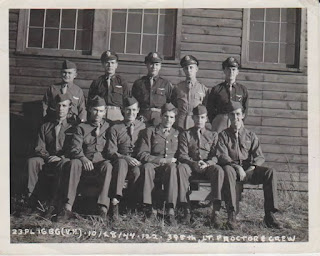
The crew of the Coral Queen consisted of 2nd Lt Joseph Clinard (Pilot), 1st Lt Robert Proctor (AC), 2nd Lt Lyle Langenberg (NBR), 2nd Lt Charles Bixby (B), T Sgt Omer Lammers (FE), Sgt Clifford Williams (CFC), Sgt John Beyers (ROM), Cpl William Dembeck (LG), Cpl Vernon Damm (RG), Cpl James Davis (SG), and Cpl James Flaherty (TG). Omer Lammers is first from the left in the second row of this picture. All of the crew are listed on the Tablet of the Missing in Honolulu, Hawaii.


Sources:


Sunday, December 19, 2021

Edward Frederick Gaier (1918-1944)

This is the second biography in the WWII Hometown Newspaper Collection Project. The purpose of this project is to document the stories of individuals who served in WWII or were affected by WWII in some profound way. My portion of the project will focus specifically on those individuals from Auglaize, Darke, Mercer, and Shelby counties in Ohio.

This biography will be about Edward Frederick Gaier, my second cousin, 2x removed. 

Edward was born in Piqua, Miami County, Ohio on 25 March 1918 to Edward Mathias Gaier and Anna Mae Moyer Gaier. The 1920 US Census indicates that the family, consisting of Edward Sr. (age 31), Anna (age 37), Herald (age 8), Ruth (age 7), Sarah (age 4 years 11 months), Veronica (age 3 years 3 months), and Edward Jr. (age 1 year 9 months), owned their home at 1002 West North Street in Piqua, Ohio. Edward Sr. was a laborer at the packing house.

During the 1930 US Census, the family was living in the same home, which was valued at $4,000. The family also had a radio which was an important technological innovation of the time. The family at that time consisted of Edward Sr. (age 42), Anna (age 43), Harold (age 18), Ruth (age 17), Sarah (age 15), Verra (age 12), Edward (age 11), Betty (age 9), George (age 7), and Anna (age 5). Edward Sr. was a salesman for the S. Zollinger company at this time.

The 1940 US Census indicates that the family had moved to McLean Township, Shelby County, Ohio by 1935. Other evidence indicates that they moved to this location in the spring of 1935. At the time, the family consisted of Edward Sr. (age 51), Anna (age 53), Edward Jr. (age 22), Betty Jane (age 17), and Anna May (age 8). Edward Sr. was working as a salesman for the S. Zollinger company, a wholesale grocery. Edward Jr. had completed 1 year of college at the time. Edward Sr. died on 6 July 1941.

Edward graduated from Ft. Loramie High School in May 1938 and then worked at Monarch Machine Tool Company in Sidney, Ohio for four years. He also attended Ohio State University for two years. He married Ruth Kirner on 13 June 1942 at St. Michael's Church in Ft. Loramie. They had one child, a son. On 30 October 1942, he  enlisted in the Army Air Corps at Patterson Air Field in Fairfield, Ohio. This is now Wright-Patterson Air Force Base. After a short stay at Patterson Air Field, he was sent to Kessler Field in Mississippi and then to Chicago Technical School in Chicago, Illinois. He was trained to be a radioman and a gunner on a B-24 Liberator bomber with the 460th Bomber Group. After his training, he was sent to Kearn's Air Field in Salt Lake City, Utah where he earned the rank of Staff Sargent. His service also included short assignments at Buckingham Field in Fort Myers, Florida, Chatham Field in Savannah, Georgia, and Mitchell Field in New York before being sent oversees on 26 January 1944. While at Buckingham Field, he represented his unit in national gun shooting competitions and won a first in skeet range shooting and third in air-to-air battles at a meet in Kingman, Arizona. 

He was assigned to the 760th Bomber Squadron of the 460th Bomber Group. On 19 February 1944, while on a bombing mission over Italy, his B-24H Liberator (41-29339) crashed near Acerenza, Italy due to weather. S-Sgt Edward F. Gaier was buried in Forest Hill Cemetery, in Piqua, Miami County, Ohio.